Figures supplied by the site owner; not independently verified.
18+ · Offer terms
18+. Bonus wording, rating and review count were supplied by the site owner and have not been independently verified. Check availability, eligibility and current bonus terms with the operator for your location. Gambling carries financial risk.
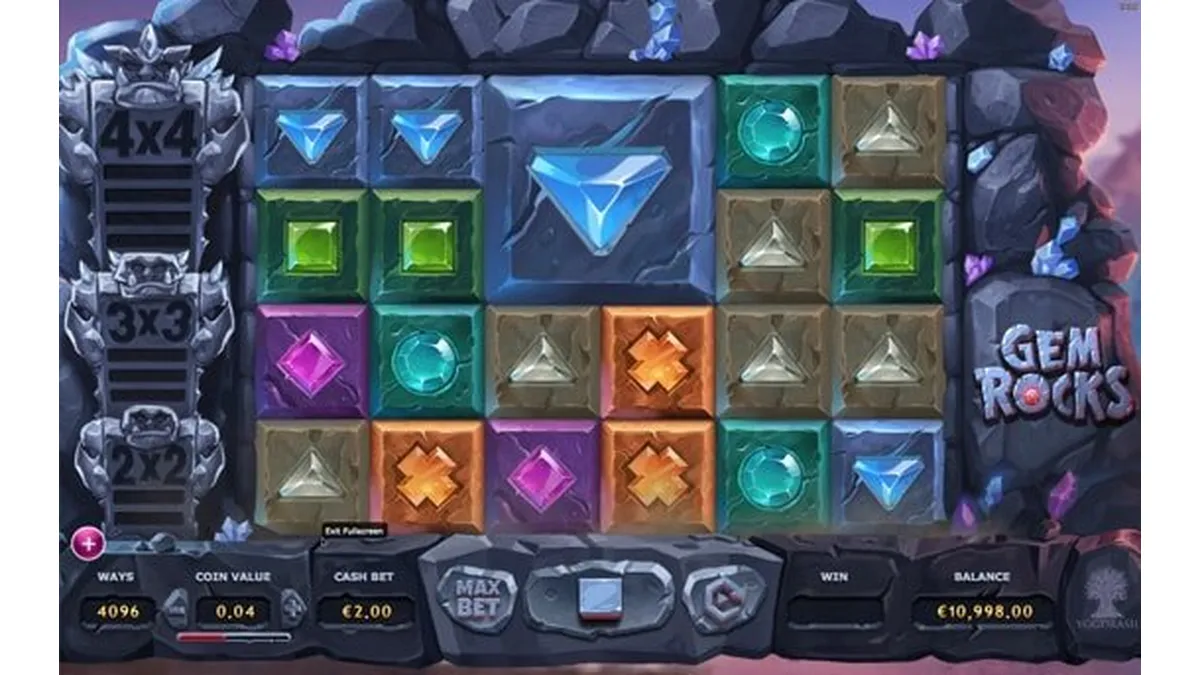
Gem Rocks slot links cascading wins with oversized blocks of matching symbols. Follow the consecutive-win sequence and the Monster Rock meter rather than expecting a conventional scatter-triggered free-spin round.
A monster changes the footprint of symbols within the cascade sequence.
Gem Rocks at a glance
Published game information
Payout structure
4096 ways
RTP published by provider
96.2%
Provider volatility
High
Large symbol block
Up to 4×4
Release
22 February 2018
Mobile
Yes
Explore the Gem Rocks features before choosing a session
Read the consecutive-win milestone separately from the block's visual size.
Read the game rules and look for a practice option in the game catalogue. A casino welcome offer is a separate choice from this game’s features.
Yggdrasil combines all-ways payouts, descending replacements and giant gem blocks in Gem Rocks. A completed chain and its meter explain feature progress more clearly than the size of an isolated symbol.
Gem Rocks slot combines ways wins with descending replacements
Gem Rocks uses matching symbols across its reel structure rather than asking you to select an ordinary payline pattern. Read the game's ways information before comparing it with a fixed-line fruit machine.
A symbol's appearance and its contribution to a combination are separate observations. Several matching gems can be visible without every copy belonging to the particular result that the game highlights.
When a winning sequence continues, replacements create another board to evaluate. The important distinction is between the paid instruction that began the round and the successive outcomes resolved within that instruction.
The provider connects these cascades with oversized groups of matching symbols. Those blocks are a feature of the reel layout, so their position matters alongside their apparent width and height.
Read consecutive wins as a connected sequence
A consecutive-win meter records progress within the qualifying sequence described by the game. It should not be confused with a lifetime counter showing how many earlier paid rounds produced any return.
Follow each replacement after its result resolves. The next successful combination can extend the chain, while a replacement without another qualifying win brings that particular sequence to its endpoint.
This makes the reset meaningful when interpreting a board. A meter returning to its starting state does not establish that the next paid round has become more likely to produce a feature.
Keep the round's final return separate from the number of successful-looking animations. A chain can contain several evaluated outcomes, while the completed financial result still belongs to the original paid instruction.
The published mathematical model does not forecast the next cascade
Yggdrasil publishes an RTP of 96.2% and classifies Gem Rocks as high volatility. These are provider figures describing a game model, rather than a promise about a particular person's session.
A theoretical return concerns many outcomes over the long run. It cannot tell you that a monster must arrive after an unproductive run or that an almost-reached meter threshold is now owed.
The volatility label concerns the distribution of outcomes, including their variation. It does not turn a large symbol block into an affordable spending plan or identify how long a session should last.
Read the information attached to the version you open when comparing configurations. A provider publication gives useful context, while the game's current information panel identifies the model and rules being presented there.
A large symbol block changes the positions used by the cascade.
An illustrative chain reaches its first monster milestone
Imagine a paid round producing a qualifying gem combination. Watch the winning positions resolve, then identify the replacement symbols that enter the spaces created by that first outcome.
In this illustrative sequence, the replacement board also produces a qualifying result. That extends the consecutive chain, bringing the meter to its first monster milestone described in the operator's game explanation.
A monster block now occupies several positions with matching symbols. Follow where that block lands and which highlighted combinations use it, instead of treating its visual size as the final payout amount.
Imagine the following replacement failing to produce another qualifying combination. The chain ends there, so the meter and final result must be read at that endpoint rather than extended in your imagination.
The example explains how a meter milestone can follow connected outcomes within a round. It does not describe an outcome you can reproduce by changing timing, stake size or click order.
The Monster Rock feature changes the footprint of matching symbols
The operator's explanation associates different consecutive-win milestones with progressively larger monster blocks. That progression concerns the size of a matching-symbol group introduced onto the reels, rather than a conventional free-spin allocation.
A larger block can occupy several symbol positions at once. Read the combinations it actually creates under the game's payout rules instead of assuming that every occupied position pays independently.
The block's dimensions do not themselves establish a universal multiplier. Multiplying a remembered symbol value by its width and height would replace the game's rules with arithmetic the interface has not justified.
Position remains important after a monster appears. A block near one side of the reels should be interpreted through the highlighted result, not through the visual impression that it dominates the board.
After its outcome resolves, continue following the cascade sequence until the game closes the round. A monster animation is part of that sequence, rather than evidence that another paid instruction has begun.
Monster-symbol thresholds described in the Canadian game guide
Consecutive wins
Monster block
Reading task
2
2 × 2
Follow the larger symbol through the next replacement
5
3 × 3
Distinguish block size from a guaranteed payout
9
4 × 4
Read the resolved combination before another cascade
Large symbol groups are different from connected-cluster payouts
Gem Rocks and Contact can both show large groups of similar symbols, but that does not make their payout structures interchangeable. Establish whether the game describes ways combinations or edge-connected clusters first.
Contact's retained groups provide a useful comparison because their persistence is explicit. In Gem Rocks, follow the game's replacement sequence and monster blocks rather than importing another title's rule for what remains.
This distinction prevents attractive terminology from replacing a rule check. A page calling everything a cluster should still explain what arrangement qualifies and how the game evaluates the positions involved.
The feature focus differs from an ordinary free-spin round
The operator's Gem Rocks explanation describes its cascading and monster features without a standard free-spin bonus. That changes what you watch for when trying to understand the next announced event.
A chain continuing without another stake deduction is not necessarily the same thing as entering a separately counted free-spin feature. Read the announced mode and the existing round's progress together.
Do not count each falling set of symbols as a fresh purchased spin. Keep the selected stake attached to the paid instruction, then compare its completed result when the chain finishes.
If you prefer watching a counted bonus, Big Bite offers a contrasting structure through its free-spin feature. That preference concerns presentation and rules, without establishing which game would produce a better outcome.
Check the total stake before using a faster control
Find the stake selection and game information before beginning a round. The size of the artwork does not tell you how much the next paid instruction will use from the displayed balance.
If a faster play setting is offered, read how it changes presentation before using it. Shorter animations should not replace your ability to recognise a completed chain and its final result.
A maximum-stake control, where available, needs particular attention because it concerns the amount selected for the next instruction. It is different from a control that merely adjusts sound or display.
After leaving and reopening the game, inspect the current amount and balance mode again. A familiar monster image does not prove that the stake remains identical to your earlier setting.
Confirm Gem Rocks rather than another gem-themed title
Use the complete Gem Rocks title and Yggdrasil attribution when checking identity. A similar cavern backdrop or collection of coloured stones does not establish the same meter, monster thresholds or payout structure.
A provider demonstration and an operator window may also show different account contexts. Identify the balance mode before treating a number visible in one window as evidence about another account.
The published provider volatility classification differs from wording on an operator metadata card. Use the identified source and the opened game information instead of silently combining those descriptions into one claimed configuration.
Decide the allowance before a meter creates urgency
Choose an affordable session limit before starting play, and keep it independent from the meter. A threshold that appears close is still a feature condition rather than a reason to increase spending.
When a chain ends, assess the available balance before beginning another paid round. Starting again creates another decision even if you remember the previous board as nearly reaching a larger monster.
Do not use the dimensions of a previous block as your measure of session success. The useful comparison is the amount available before play and the money remaining after the resolved outcome.
A high-volatility classification makes a clear spending boundary useful, but it does not dictate an ideal stake or session length. Those choices must remain tied to what you can afford.
Compare persistence, collectors and changing reel heights
The Wiz carries a dragon across successive feature positions, while Gem Rocks changes the footprint of symbol groups. Compare what remains active and how its position can contribute to another result.
Big Bite instead relies on orca collectors and prize symbols in different reel positions. Watching a collector gather a displayed prize is a different sequence from evaluating another cascade of matching gems.
Hypernova Megaways provides another contrast through changing reel heights and a separate respin feature. A shared cascade effect does not mean that its feature trigger can be transferred to Gem Rocks.
Choose the structure you can follow without confusing its counter or balance mode. Familiarity helps you read a sequence, but it does not make the next outcome predictable or remove spending risk.
Use the resolved round as the point for review
At the end of the chain, identify the final result before starting another instruction. A temporary meter value or monster animation should not replace the balance record that follows completed resolution.
If the result is unclear, retain the round reference and describe the last event you understood. Naming the replacement sequence or monster block gives a precise question than saying something looked wrong.
Use the game rules for questions about symbol evaluation and the account support route for disputed balance entries. Those enquiries may concern different records even when they arise during the same session.
Finish by checking the selected stake and remaining allowance. Understanding the monster sequence should make the next decision more deliberate, without turning feature analysis into a claim that losses can be recovered.
Gem Rocks questions
How do I activate the Monster Rock feature in Gem Rocks?
The operator describes consecutive cascade wins building the monster meter. Follow the current chain and its qualifying milestones; an earlier paid round's result does not establish progress for every later round.
What is the Gem Rocks dropdown wins feature?
Winning symbols disappear and new symbols descend into their positions. A further qualifying combination extends the same chain, so wait for its endpoint before comparing the completed result with your balance.
What is the highest-paying symbol in Gem Rocks?
The operator article identifies the red-and-gold star as the highest-paying symbol. Read its value and the qualifying combination in the opened paytable rather than judging symbol worth from size or brightness.
Game facts refer to the named publication or game-help configuration. An account may use a different version. Welcome-offer eligibility is separate from the game rules.